View all blogs
The view from above the objection letter: personal auto rate filing trends
Market insights

By
Insuraviews
November 5, 2026

Most objection work centers on getting an individual filing approved. Looking across many filings shows a different picture: which topics departments raise most often, how that mix is changing, and where states differ. This article summarizes personal auto rate filings and objection correspondence from the past three years.
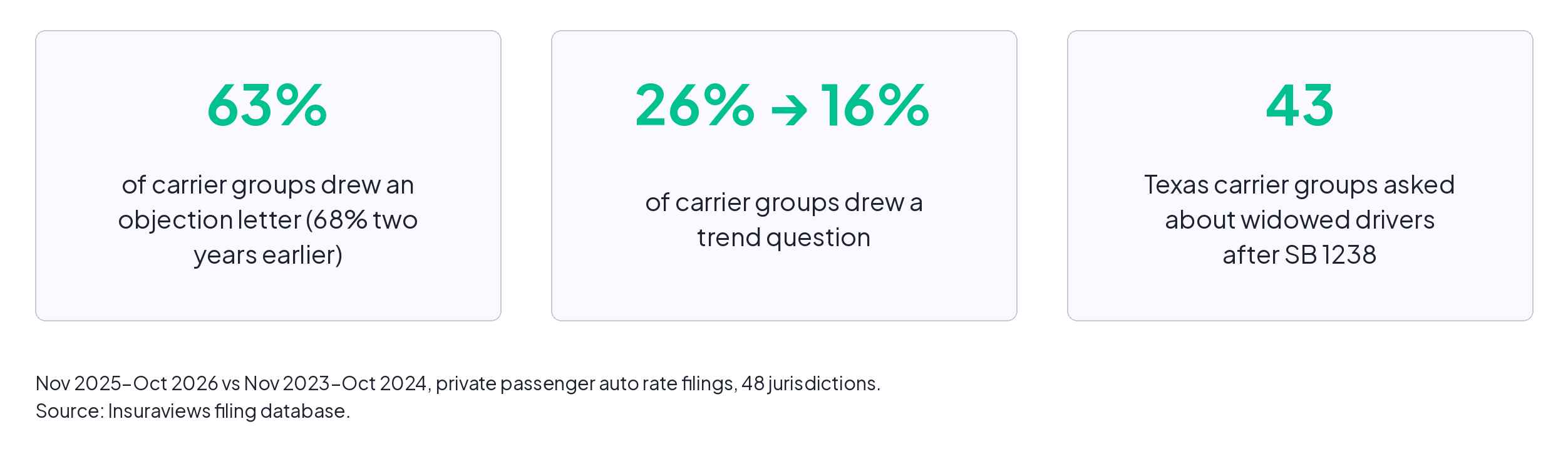
Over the past year, 63% of carrier groups filing rates in a state drew at least one objection letter, down from 68% two years earlier. Most of the decline came from fewer trend and profit-provision questions. A smaller set of issues, including rating-factor restrictions, minimum-limit changes, capping rules and, for a few carriers, tariff adjustments, reached fewer carriers but bears directly on what states will approve.
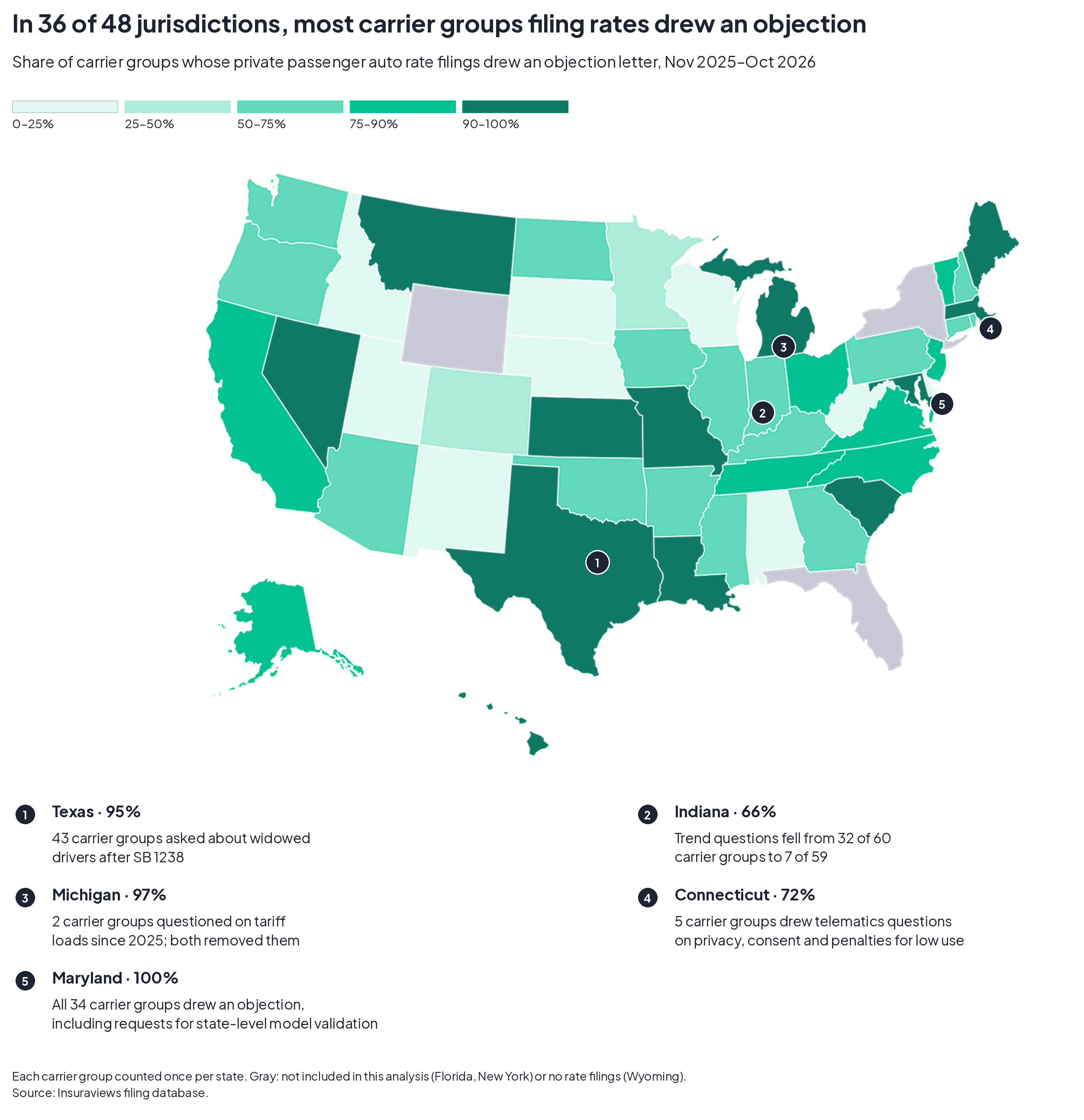
In most states, a majority of carriers filing personal auto rates receive an objection letter. In 20 jurisdictions at least three in four carrier groups filing rates drew one, and in Maryland, Massachusetts and Hawaii every group did. At the low end, Alabama and Delaware had no objection letters on record; an Alabama filing we checked was approved in eight days without one.
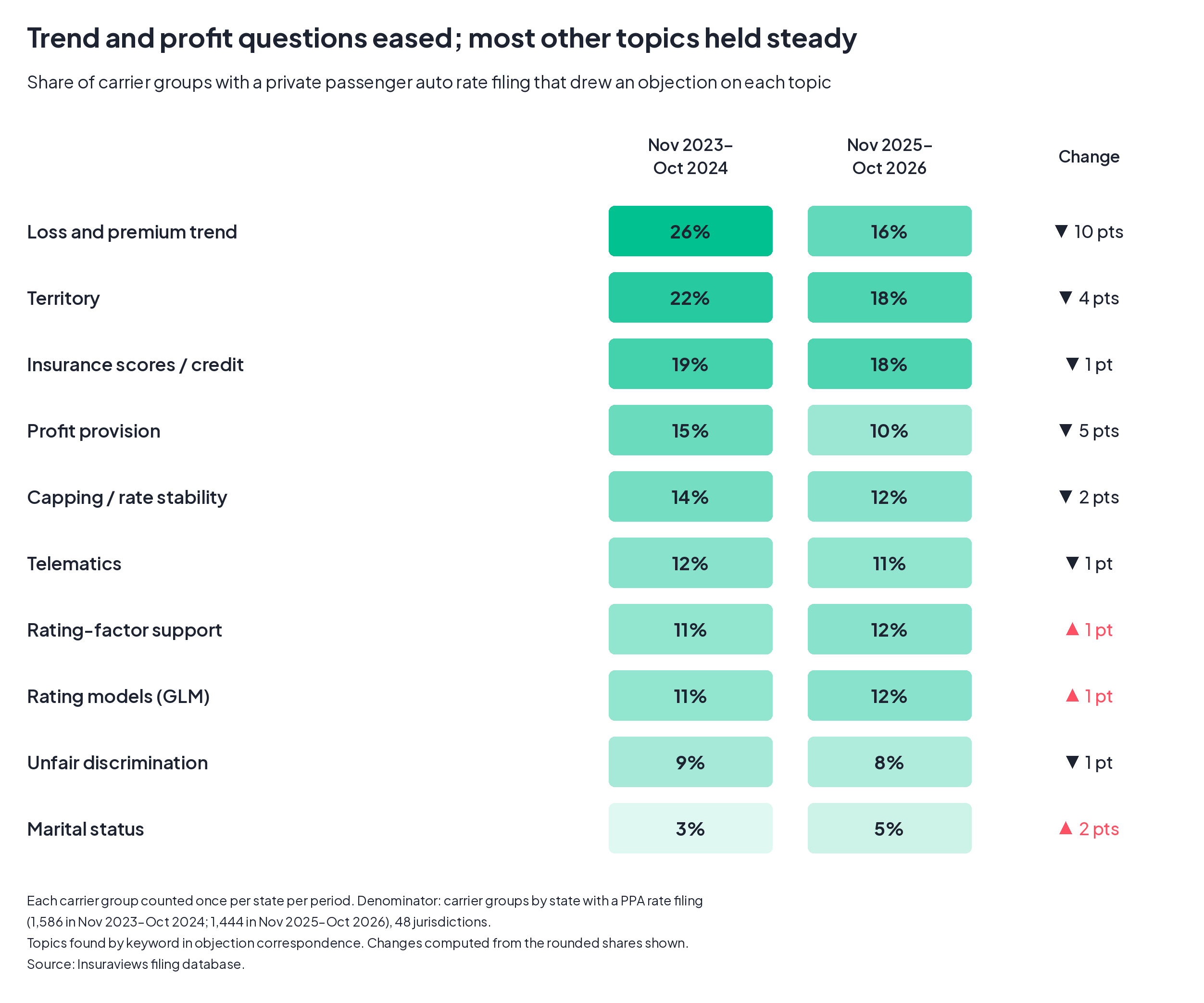
Only two of the ten topics we track moved meaningfully: loss and premium trend fell ten points and profit provision fell five. Every other topic moved four points or less. Territory and insurance scores are now the most common topics, at 18% of carrier groups each, with trend third at 16%. Rating-factor support, rating models and marital status each edged up, even as letters overall became less common.
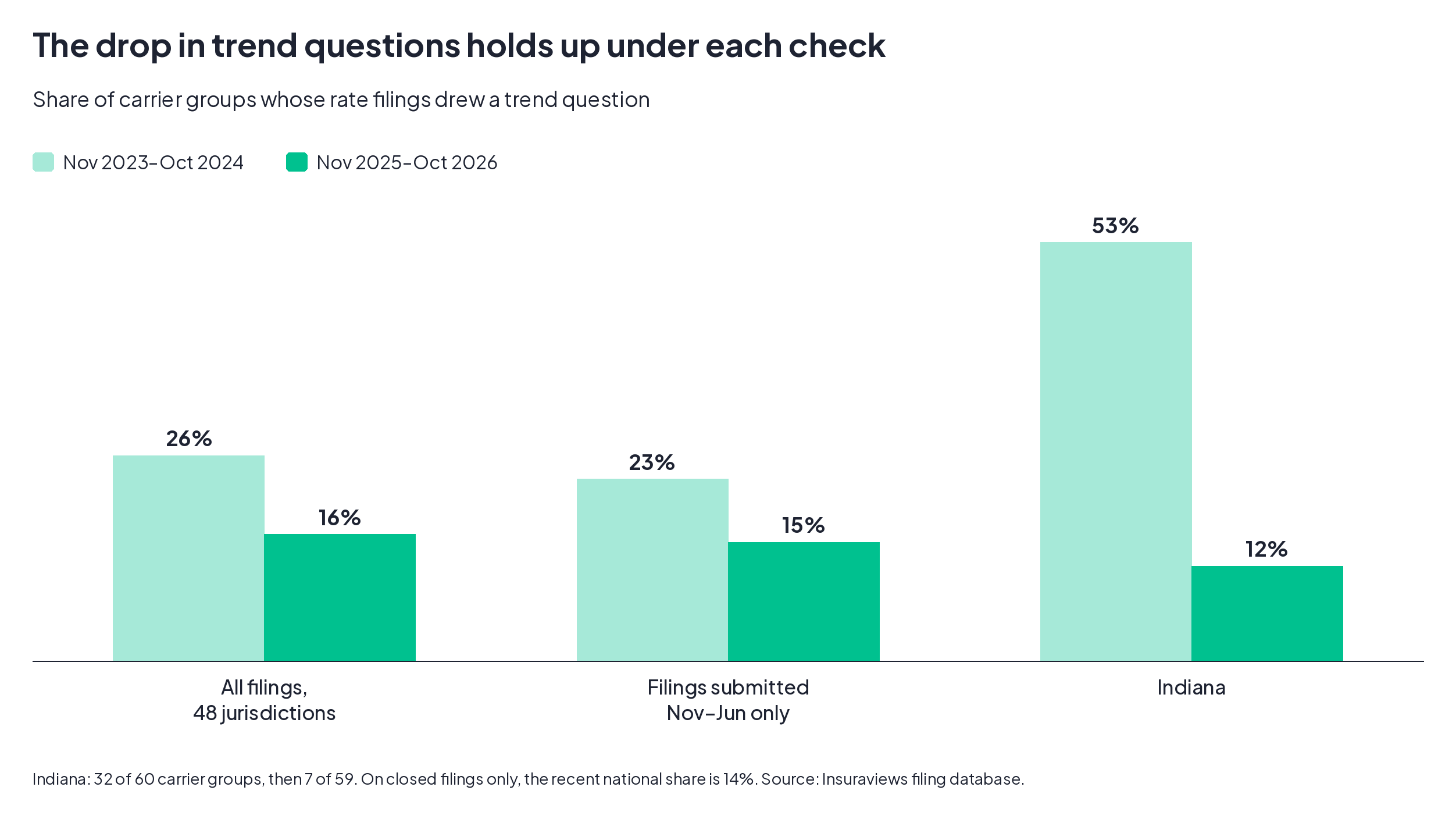
The decline in trend questions holds up when the comparison is narrowed to filings submitted in the same months of each year, and it is steepest in Indiana.
The trend letters that remain are more targeted. Rather than ask for general support, they question a specific selection that departs from a benchmark: COVID-era fit periods in California (PERR-134964330), trends selected below the indication in Maine (ALSE-134894688), and, in some recent letters, a positive trend when industry data pointed lower (OAMF-135089039). Profit-provision questions fell along with trend.
Capping, telematics, tariff and minimum-limit questions reach relatively few carriers, but they question the rating rule itself rather than the support behind it, so the answer is often a change to the rule. Both Michigan carrier groups questioned on tariff loads removed them.
Rating models and rating-factor support were among the few topics to rise, and the questions increasingly ask whether a countrywide model holds up in the state. Arizona now asks for an Arizona-only lift chart (GMMX-134492762), Maine asks whether validation reflects Maine data (GMMX-134461613), and Maryland and Connecticut have asked for state-specific validation. In these states, it pays to prepare state-level validation before filing.
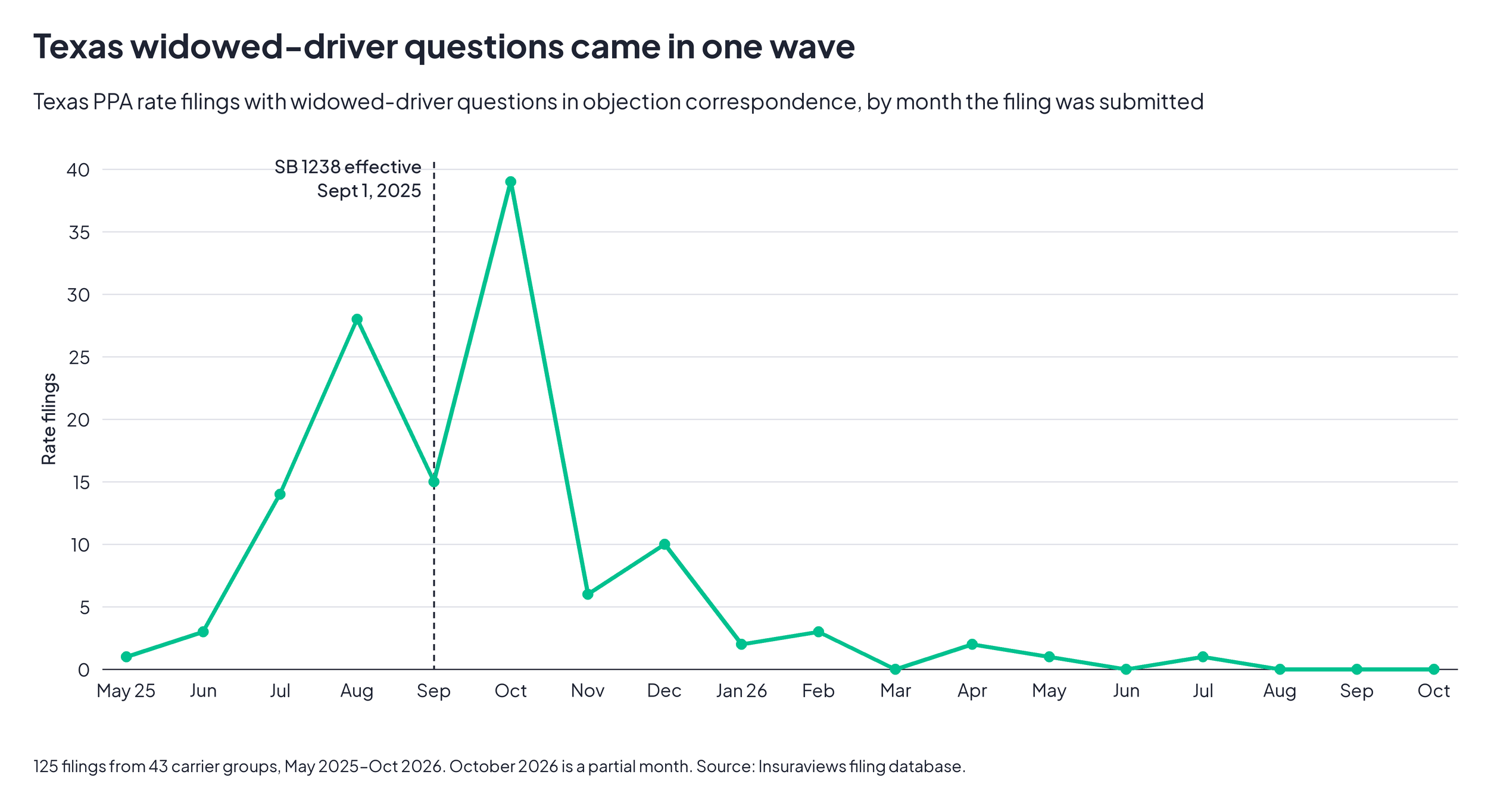
Senate Bill 1238, effective September 1, 2025, bars insurers from charging a widowed persona rate different from the married rate.
Letters first asked carriers to rate widowed drivers as married, including in tier and underwriting point models. Later letters asked how many such policies were written between September 1 and the effective date of compliant rates, and at what premium (HMSG-134715150).
AI shows up mainly in filing requirements. Connecticut's checklist asks whether AI or machine learning is used in rating, tiering or eligibility. Washington filings in 2026 include a question on whether AI tools were used to create or review the filing, and Georgia model questionnaires in October 2026 filings ask how AI was used to build the model.
In objection letters, regulators raise machine learning as part of model review: which technique was used, how it was validated, and whether checklist answers match the filing. Connecticut asked one carrier to correct a checklist that said noAI or machine learning was used when its primary model was a gradient boosting machine, and Montana asks carriers to disclose every statistical or machine-learning method used to build modeled factors. We found such letters in at least four states but could not count them reliably, because the same words appear throughout checklists, filing questions and copyright notices.
A carrier’s own objection letters show what one department asked about one filing. The trends in this article only appear across many carriers, and each line you write has its own. Knowing what departments are asking in each of your lines, and how that is changing, lets a filing team plan for questions instead of reacting to them.
Insuraviews tracks rate filings and objection correspondence across all P&C lines in every state, by topic and carrier group, so you can see what a department recently asked comparable carriers before your next filing goes out.
Log in and give it a try, and as always, let us know what you'd like to see next.
Not yet a customer? Schedule a demo of Insuraviews today to see what you're missing.


© 2026 Insuraviews. All rights reserved.