View all blogs
Your AI tools can now read millions of insurance filings
Tech & innovation

By
Insuraviews
November 10, 2026
In 2025, 68 carrier groups submitted 223 homeowners rate filings in Texas, according to Insuraviews data as of November 2026. Allstate led with 26, followed by Farmers with 18 and Liberty Mutual with 15.
Finding those numbers used to mean logging into a research tool, building a query, exporting the results, and pasting them into a spreadsheet. Today it took one sentence typed into an AI assistant.
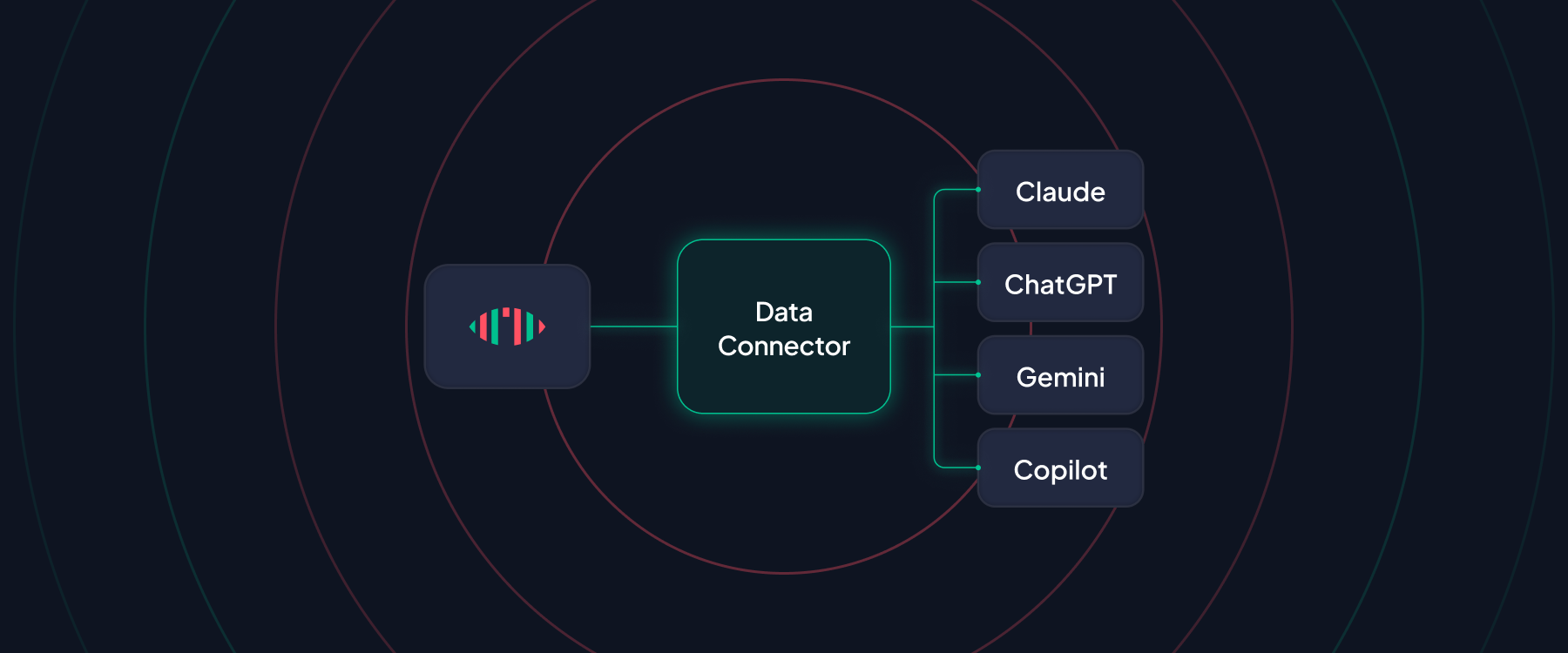
That is the idea behind the Insuraviews Data Connector, now available in production. It connects the AI tools your teams already use to Insuraviews' database of more than 2 million structured property and casualty filings across all 50 states and DC.
Most carriers have rolled out at least one enterprise AI assistant over the last two years. Microsoft 365 Copilot, ChatGPT Enterprise, Claude, and Gemini are now standard tools in many product, pricing, and compliance teams.
But ask any of them about a competitor's latest rate filing and you hit a wall. General-purpose models don't have reliable access to SERFF filings, and the public web is a poor substitute: filings are scattered across state systems, buried in PDFs, and often unsearchable. The result is either a refusal or, worse, a confident answer built on nothing.
Meanwhile, the questions keep coming. What did our top three competitors file in Ohio personal auto this year? How are carriers wording roof surfacing schedules in Florida? These questions shape rate strategy, form development, and regulatory planning, and they deserve answers grounded in the actual filings.
The volume alone outpaces any research team. Carriers submitted more than 27,000 homeowners rate filings nationwide from 2021 through 2025, peaking at over 6,200 in 2023, according to Insuraviews data. That is roughly 25 new homeowners rate filings every business day, before counting auto, commercial lines, rules, or forms.
Keeping pace with that flow is what lets a product team defend rate adequacy, spot a competitor's shift in appetite before it shows up in the book of business, and walk into a regulator conversation prepared. AI assistants are well suited to that reading and synthesis, but only if they can reach the filings themselves.
Governance matters just as much. The NAIC's model bulletin on insurers' use of AI, adopted in December 2023 and since taken up by many states, expects carriers to document and oversee how AI informs their decisions. An answer about a competitor's filing is only useful if someone can trace it back to the source document. That requirement shaped how we built the connector.
The Insuraviews Data Connector is built on the Model Context Protocol (MCP), the open standard that Anthropic, OpenAI, Google, and Microsoft all support for connecting AI assistants to trusted data. One connector works across every major platform, so your teams can use Insuraviews in whichever assistant your company has standardized on.
Once connected, users simply ask a question. The assistant decides when it needs filing data, calls Insuraviews to search, count, or read filings and their attachments, and then does what AI assistants do well: summarize, compare, draft, and explain.
A few questions you can ask:
Every filing the assistant cites links back to the full filing in the Insuraviews app, so analysts can verify the source in one click before anything goes into a rate memo or a board deck.
Depending on your AI assistant’s capabilities, you can also:
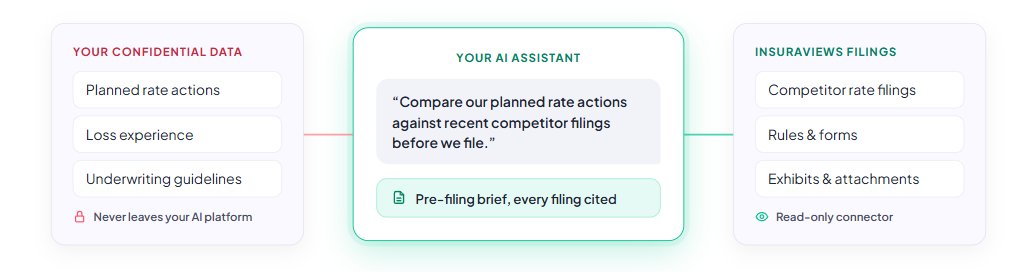
We designed the connector around the questions carrier security and compliance teams ask first.
It is read-only. The connector can search and retrieve Insuraviews data, but it cannot write, upload, or submit anything back to Insuraviews.
Your work stays in your environment. The summaries, analyses, and drafts your assistant produces stay inside your AI platform and follow the security, retention, and compliance policies you already have in place.
Access follows the user. Each person signs in with their own Insuraviews account and sees only the data their subscription includes. There are no shared API keys to distribute or rotate, and admins on each platform control who can use the connector.
Answers stay grounded. The connector instructs the assistant to lead with facts taken directly from the filings, link every filing it mentions, flag when an answer rests on a partial read, and clearly mark anything drawn from AI-generated summaries. AI assistants still make mistakes, which is why every claim comes with a link to its source.
Insuraviews is now listed in the Claude Directory, so Claude users and admins can find and install it in a few clicks. The connector also works today with:
Listings in the ChatGPT app directory and the Microsoft partner marketplace are on the way. Until then, admins can add the connector in minutes using our setup guides.
This is the first release. We are already working on DOI review analytics, such as review times by state and line, so your assistant can help answer not only what competitors filed, but how regulators are likely to respond.
The Data Connector is an add-on to the Insuraviews platform. How you get started depends on whether you already use Insuraviews.
Already an Insuraviews customer? Email your account team at sales@insuraviews.com to add the Data Connector to your subscription. Once it is enabled, install Insuraviews from the Claude Directory or follow the setup guide for your platform at docs.insuraviews.com.
New to Insuraviews? Request a demo to explore the Insuraviews platform, from filing search and carrier reports to DOI analytics, and see the Data Connector working in your team's AI assistant.
Your teams are already asking their AI assistants about the market. Now those assistants can answer with the filings.
Learn more about our data connector here: AI Data Connector for P&C Filings | Insuraviews


© 2026 Insuraviews. All rights reserved.